![[object Object]](https://img-va.myshopline.com/image/store/2000678933/1663746048441/39b6b7c932914f9586953fa6dbb3e95c.png?w=1694&h=200)
Eyelash Lace Trim vs Scalloped Lace Trim: What’s the Difference?
Sep 27,2026 | LaceFabricShop
Introduction: The Edge Can Change the Whole Design
When two lace trims have similar decorative patterns, the edge finish can make a major difference in how the trim looks on a finished garment. One edge may create a soft, fringe-like outline, while another may form a repeated curved border that reads as a clearer frame.
Eyelash Lace Trim and Scalloped Lace Trim are useful comparison terms for thinking about that visual boundary. They do not replace the need to inspect a specific product page. Actual lace can vary in motif scale, construction, width, material, elasticity, color and continuity. The practical choice is not about deciding which category is universally better. It is about choosing the edge effect that supports the garment, the fabric and the intended finish.
1. What Is Eyelash Lace Trim?
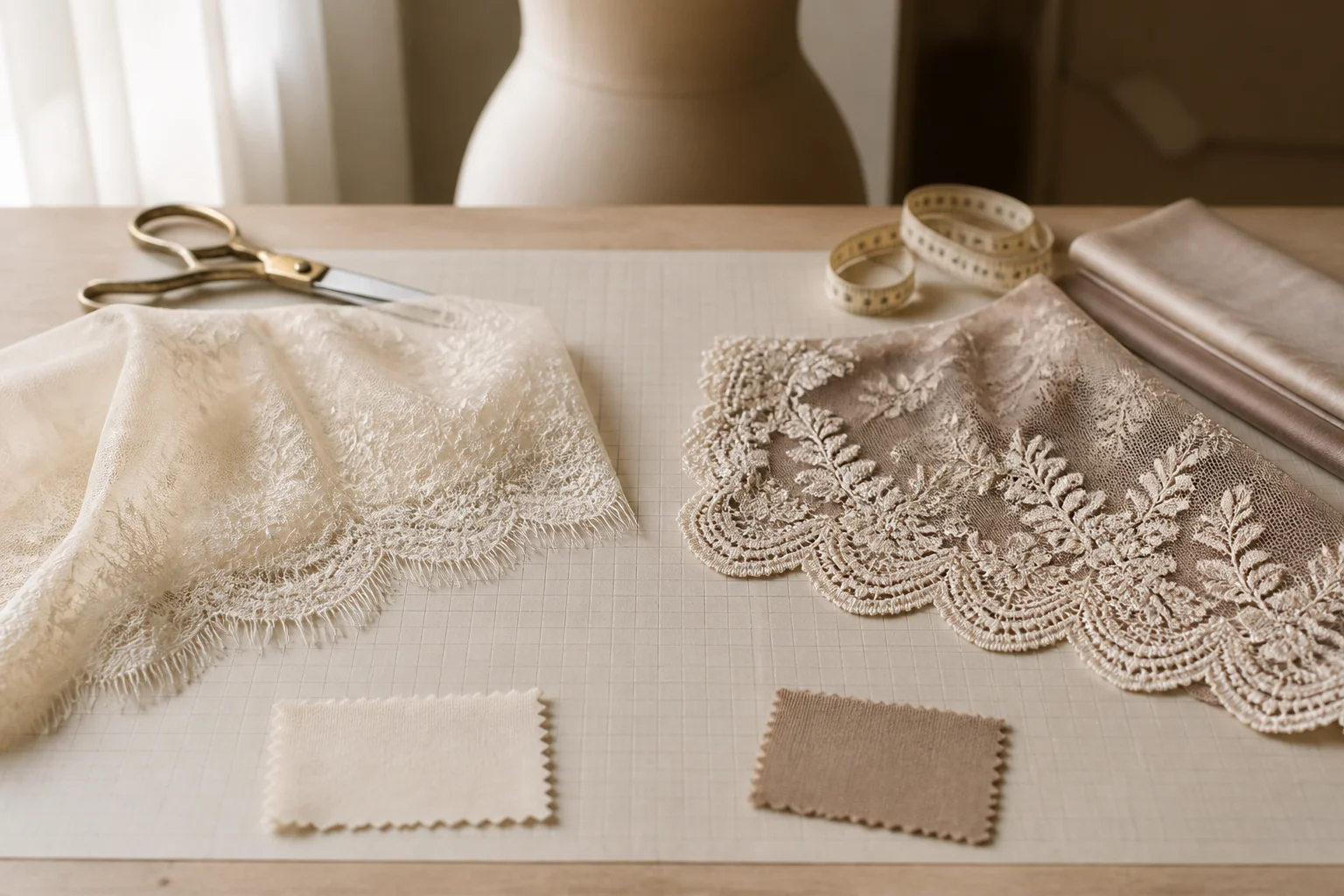
Eyelash Lace Trim is commonly used to describe lace with a delicate fringe-like or lash-like edge. The outline can appear soft, irregular and lightly feathered rather than ending in a single, strongly defined curved border. From a distance, that edge may create a subtle halo around the lace. Up close, it can add a fine decorative texture.
This kind of edge may suit designs where the lace should look delicate, romantic or gently blended into the garment. It can soften the transition between trim and base fabric, especially when the designer wants the border to feel less geometric. On a neckline, sleeve, cuff or lingerie detail, an eyelash-style edge may provide a light decorative outline instead of a bold frame.
These are general visual considerations, not universal product specifications. An Eyelash product may still differ in width, motif density, material, elasticity and overall structure. For example, the current LaceFabricShop record for Eyelash Lace Trim for Garment Embellishment Width 7 cm LT0061 records No for Elasticity and lists variants titled A#White 300x7.5 cm, A#Black 300x7.5 cm, B#White 300x7 cm and B#Black 300x7 cm. Those details belong to that specific product record; they do not define every Eyelash Lace Trim.
2. What Is Scalloped Lace Trim?
Scalloped Lace Trim is commonly understood as lace finished with a repeated series of rounded or curved sections along the edge. The curves can create a more clearly defined decorative border, almost like a sequence of small arches. Depending on the motif and scale, a scalloped edge may read as classic, structured, playful or formal.
Because the edge repeats in a visible rhythm, Scalloped Lace Trim can be useful when the garment needs a border that clearly frames an opening or finishing line. It may work well around a hem, skirt edge, cuff, sleeve opening or decorative panel where the edge itself is intended to be noticed.
Scalloped does not automatically tell you the product’s material, fiber, stretch, width or weight. A scalloped-looking edge can appear on products with very different construction details. Before ordering, inspect the actual image, product description and variant record. Confirm the edge shape at the scale at which it will be used rather than relying only on the category label.
3. Eyelash vs Scalloped: The Visual Difference
The simplest distinction is the way the border is read by the eye. Eyelash edges tend to suggest a softer, finer or more irregular outline. Scalloped edges tend to create a repeated curved boundary with more obvious rhythm. Neither effect is automatically better; each can support a different design direction.
| Comparison point | Eyelash Lace Trim | Scalloped Lace Trim |
|---|---|---|
| Edge appearance | Delicate fringe-like or lash-like outline | Repeated rounded or curved border |
| Overall visual character | Soft, fine and lightly textured | Defined, rhythmic and more clearly framed |
| Border definition | May blend gently into the base fabric | Can create a visible contour along the garment edge |
| Typical design effect | A softened, delicate finish | A framed, decorative finishing line |
| Suitable applications | Necklines, sleeves, cuffs and delicate details when a soft edge is desired | Hems, skirt edges, borders and finishing lines when the contour should be visible |
| What to check | Actual fringe appearance, width, motif scale, material and elasticity | Curve rhythm, repeat scale, width, construction and application direction |
Choose based on the desired visual effect, not on a general ranking. A soft eyelash edge may suit one neckline, while a defined scalloped border may work better on another garment with the same base fabric.
4. Eyelash Lace Trim for Dresses, Necklines and Sleeves
An eyelash-style edge may suit garment areas where the border needs to feel light or gently integrated. On a neckline, the fine outline can frame the opening without creating a heavy geometric line. On a sleeve or cuff, it may add a small decorative finish that follows the movement of the garment visually.
For bridal details, the effect may work when the designer wants the trim to complement rather than dominate the dress. It can also be considered for delicate garments or lingerie-inspired details where a soft edge is part of the visual language. The final result still depends on the base fabric, motif density, color contrast and scale of the lace.
Current LaceFabricShop examples should be read as individual records. Eyelash Lace Trim for Garment Embellishment Width 5 cm LT0187 is listed with variants titled A#White 300x4.5 cm, A#Black 300x5 cm, B#White 300x4.5 cm and B#Black 300x5 cm. Its product record states No for Elasticity. This can help a designer understand the listed options for that SKU, but it should not be expanded into a claim that every Eyelash trim is non-stretch.
For a wider lace surface rather than a narrow trim, the active record for Eyelash French Style Chantilly Lace for Wedding Dresses Width 100cm CHL0009 lists a 100 cm fabric width, black and white color options, and an Elasticity field recorded as Standard. That is a product-specific record and should be checked again before ordering.
5. Scalloped Lace Trim for Hems and Decorative Edges
A scalloped edge can be helpful when the finishing line is meant to be clearly visible. Along a dress hem or skirt edge, repeated curves can create a recognizable border and help the eye follow the silhouette. On a sleeve opening or cuff, the edge can provide a more deliberate decorative endpoint.
Scalloped borders may also suit bridal garments where the hem or panel needs an ornamental outline. The result can feel especially intentional when the curve repeat aligns with the garment’s shape. However, the scallop rhythm should be checked at the actual application length. A repeat that looks balanced in a small product photograph may feel too dense or too wide when placed around a full skirt.
At present, the current SHOPLINE title search did not return an active product with Scalloped in the product title. This article therefore does not assign a Scalloped SKU or invent a product URL. When a suitable Scalloped product is selected, confirm its current title, handle, edge image, Width, Material, Fiber, Stretch or Elasticity, Color and Roll Length directly on the product record.
6. Width Matters More Than You Might Expect
The same edge design can create a very different result at different widths. A narrow trim may read as a fine accent around a neckline or sleeve. A medium-width trim may become a stronger border at a cuff or hem. A wider decorative lace can act as a major design element rather than a small finishing detail.
Width should be judged against the garment area, not against an absolute industry rule. Consider the size of the wearer, the scale of the silhouette, the width of nearby seams and the amount of decoration already present. A very delicate dress may need an edge that remains visually quiet, while a simpler garment may support a stronger border.
The current LT0061 record illustrates why the exact variant matters: its listed options include 7 cm and 7.5 cm titles, while LT0187 lists 4.5 cm and 5 cm titles. These are real recorded options for those products, not universal categories or recommended standards.
7. Pattern Scale and Edge Design
Do not choose by edge shape alone. Motif size, pattern density and border scale can change the final effect as much as the edge itself. A fine eyelash edge paired with a large, dense motif may still create a strong visual statement. A scalloped edge with a small, open pattern may feel more restrained than expected.
- Motif size: Compare the lace motif with the garment’s seams, neckline depth and overall silhouette.
- Pattern density: Dense decoration may compete with a textured or embellished base fabric.
- Border scale: The edge repeat should look intentional along curves, corners and straight sections.
- Garment size: A small trim detail may read differently on a child’s garment, a fitted bodice or a full skirt.
- Fabric surface: Smooth, sheer and textured fabrics each change the contrast around the lace.
- Overall decoration: A beautiful lace is not automatically right for a garment with several existing focal points.
Think of the edge and the motif as one visual system. The edge provides the boundary; the pattern determines how much attention the boundary receives.
8. Stretch, Material and Other Product Details
Before ordering, check the actual product record rather than relying on the category name. Useful fields include Stretch or Elasticity, Material, Fiber, Width, Color, Pattern, Roll Length and product photos. These details can affect whether the lace is suitable for a fixed border, a curved neckline, a moving sleeve or a fitted application.
Never infer Material from a photograph, Fiber from a product name or Stretch from a product category. A product labeled Eyelash may be recorded as No for Elasticity, Standard, or have no clear field at all. Those records cannot be generalized to the whole category.
The active record for 3D Eyelash Lace Fabric Width 62 cm GL0069 records No for Elasticity, a 62 cm fabric width, black and white options and variants titled White 300x62 cm and Black 300x62 cm. These facts describe GL0069 only. They do not establish the properties of a Scalloped lace or any other Eyelash product.
9. How to Choose Between Eyelash and Scalloped Lace Trim
Use a simple decision sequence:
- Choose an Eyelash direction when you want a delicate, fringe-like or softly blended outline and the edge should not read as a strong repeated frame.
- Choose a Scalloped direction when you want a visible curved border, a repeated rhythm or a more clearly defined finishing line.
- But first check the actual edge image, Width, motif scale, fabric surface, color contrast and the construction requirements of the garment.
If the trim will be used where movement matters, verify Stretch or Elasticity for the exact SKU. If the edge will be placed around a curve, test how the repeat behaves before production. If the garment already has strong decoration, compare both options at full design scale rather than choosing from a close-up alone.
10. When Should You Order a Sample?
A sample can reduce uncertainty when this is a first-time project, when the neckline is highly visible, when the garment is bridal or custom-made, or when the base fabric is delicate. It is also useful when matching an existing fabric and when color, edge scale or pattern density is difficult to judge on screen.
Use the sample to compare the edge against the actual garment fabric. Check whether the eyelash fringe remains visible, whether the scalloped repeat looks balanced, whether the trim follows the intended curve and whether the joining method creates a clean finish. A sample is especially valuable when a small change in Width or pattern scale could alter the entire visual proportion.
11. Final Checklist
- Which edge effect do you want: soft fringe-like or clearly curved and framed?
- Does the edge complement the garment area?
- Is the Width appropriate for the neckline, sleeve, cuff, hem or border?
- Does the pattern scale match the garment and fabric surface?
- Does the product need Stretch or Elasticity?
- Are Material and Fiber details confirmed for the exact SKU?
- Does the Color match the garment fabric and overall design?
- Would a sample reduce uncertainty before production?
Conclusion
Eyelash and Scalloped Lace Trim do not have an absolute better choice. The useful distinction is the edge effect each design is trying to create. Eyelash may support a softer, delicate outline, while Scalloped may provide a more visible curved border. The final decision depends on the garment application, Width, pattern scale, fabric, construction and desired finish.
Start with the edge you want the finished garment to communicate. Then inspect the exact product record, verify every property that affects the project and order a sample when the visual scale or construction remains uncertain.
🌟 Exclusive Designer Access:
Stop wasting time hunting for the perfect lace. Explore our curated 2026 Bridal Trends and experience premium quality starting from just 0.5 meters.
Comment